Assisted Living or Memory Care? A Guide for Garden Grove Families
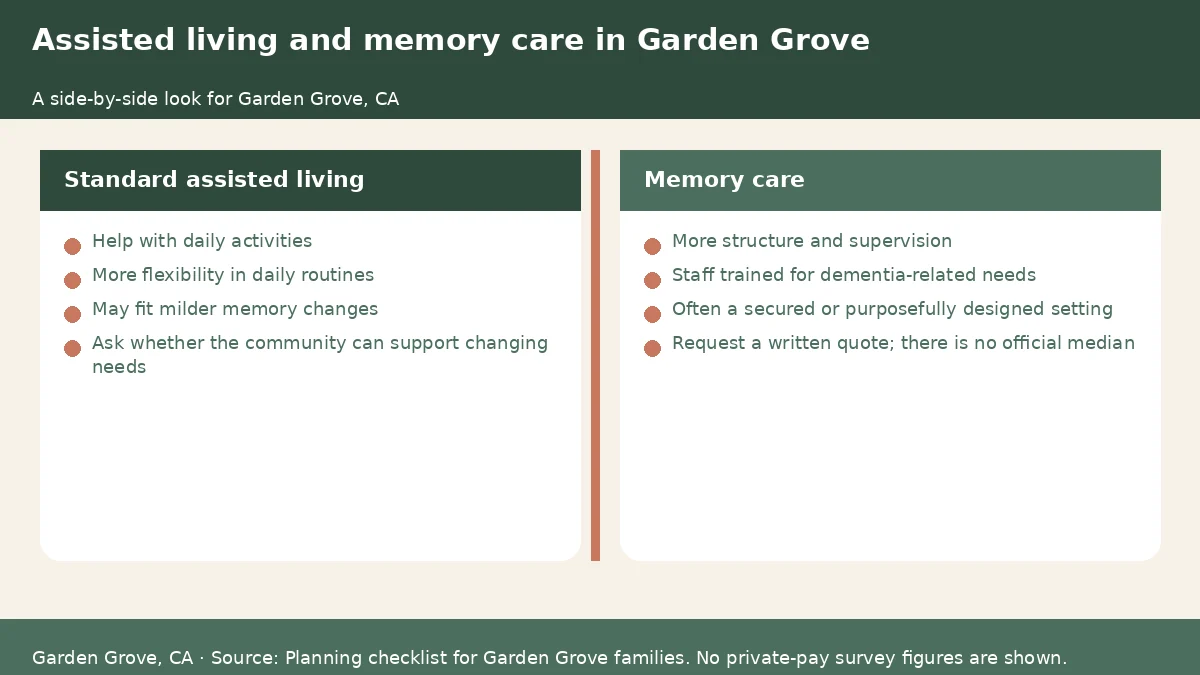
In Garden Grove, memory care is a more structured setting than standard assisted living, often with additional staffing and security. Whether someone needs that setting depends on their safety and daily-care needs, not on a national average price. Ask communities for written quotes for both options when both are appropriate.
Medicare does not pay for room, board, or ongoing custodial care in assisted living if that is the only care someone needs (Medicare.gov: long-term care coverage).
Eligible wartime Veterans and surviving spouses can review VA pension with Aid and Attendance. As of December 1, 2025, the maximum annual pension rate with Aid and Attendance is $29,093 for a Veteran with no dependents and $34,488 for a Veteran with one dependent (current VA pension rates). A surviving spouse’s Aid and Attendance maximum is $18,697 a year with no dependent children (VA Survivors Pension rates). These are benefit limits, not the price of a Garden Grove community. The net worth limit for these pensions is $163,699 from December 1, 2025, through November 30, 2026.
For local public-benefit counseling, start with the federal Eldercare Locator at 1-800-677-1116, which connects families to the Area Agency on Aging that serves Garden Grove, California.
When a parent starts having memory problems, one of the first questions families face is whether assisted living is still enough, or whether memory care is needed. The answer matters for your parent's safety and comfort, and for the family budget. This guide explains the differences in plain terms and offers a practical way for Garden Grove families to decide.
What assisted living provides
Assisted living is designed for older adults who need help with some daily activities but can still take part in community life with support. In California, assisted living settings, from large communities to small board and care homes, are generally licensed as Residential Care Facilities for the Elderly, which provide 24-hour non-medical care and supervision for people 60 and over (CDSS, resources for residents and families). Typical support includes:
- Help with bathing, dressing, grooming, and toileting
- Medication assistance
- Meals, housekeeping, and laundry
- Staff available around the clock
- Social time and activities
Many people with mild memory changes live well in assisted living, especially with reminders and a predictable routine. Caregivers can prompt them for meals and medications, help them keep track of the day, and notice early if something changes, which is often enough support for the earlier stages of memory loss.
What memory care provides
Memory care is for people whose dementia means they need more structure and supervision. It usually adds:
- Closer supervision, particularly for people who wander, become disoriented, or are unsafe alone
- Secured exits to prevent someone from leaving unsafely
- Staff trained in dementia care, including calm redirection and communication techniques
- Structured days with routines and activities adapted to cognitive abilities
- A calmer environment with fewer distractions
Memory care provides support and a safer setting. It does not cure dementia or slow its progression, and families should be wary of any claim that it does.
California rules for dementia care
California has specific requirements for residential care facilities for the elderly that care for residents with dementia, including staff training and disclosure of the dementia care a facility provides. The California Department of Social Services publishes dementia care information and resources for families as part of its Senior Care Licensing Program (CDSS, Senior Care Licensing). When you talk with a home, ask how it meets the state's dementia care requirements and what training its caregivers have completed.
Cost differences
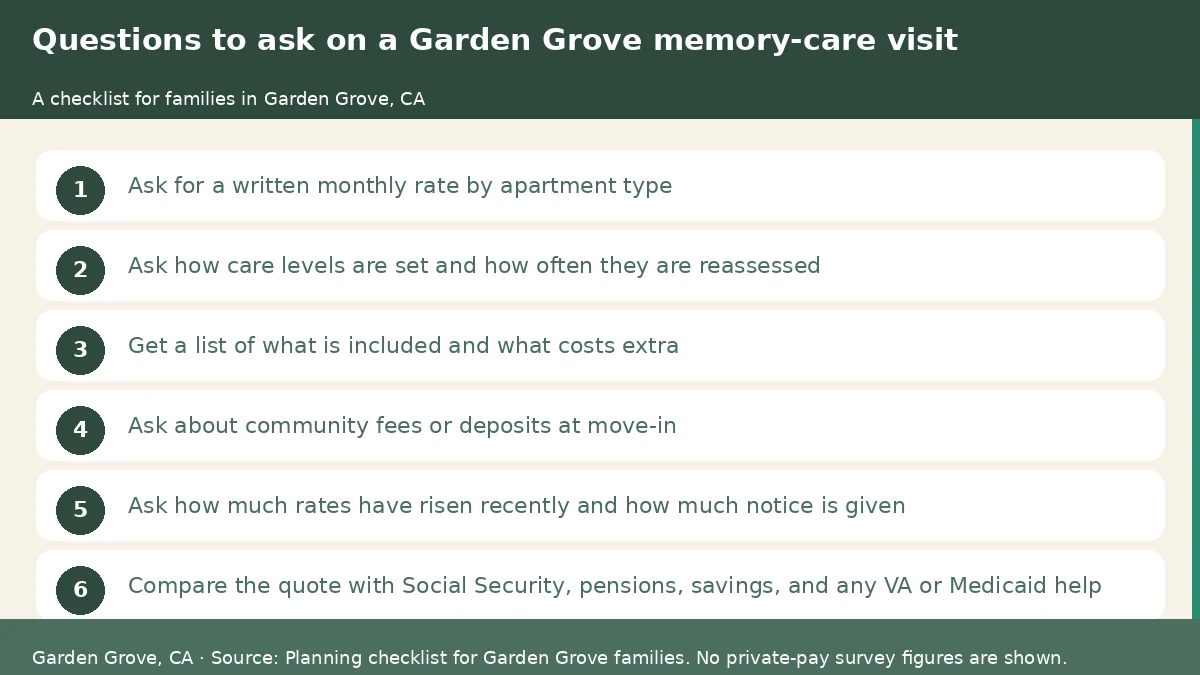
The survey does not report memory care separately. Local prices vary, so ask for written quotes. Our article on memory care costs in Garden Grove has more.
Signs assisted living may be enough
- Your parent forgets some things but follows a routine with reminders
- They are not trying to leave home or getting lost
- They can tell staff when they need help
- They sleep reasonably well at night
- They enjoy and can join in group activities
Signs memory care may be needed
- Wandering, trying to leave, or getting lost in familiar places
- Being unsafe with the stove, doors, or medications even with reminders
- Needing step-by-step help with dressing, bathing, or eating
- Agitation, confusion, or distress that increases in the afternoon or evening
- Frequent nights awake
- Not recognizing danger
The middle ground: a small residential home
In Garden Grove, some families find a middle path in a small residential care home. A household with a few residents and the same caregivers each day can offer the calm and consistency that people with memory changes often need, while still feeling like home. This works well for some people and not for others, especially those who wander persistently or need specialized programming. Ask each home honestly what it can and cannot manage. Our article comparing board and care homes and larger assisted living explores this further.
Start with a medical evaluation
Memory problems can have many causes, and some, such as medication side effects, infections, thyroid problems, vitamin deficiencies, or depression, are treatable. Before deciding on a care setting, ask your parent's doctor for an evaluation. Bring specific examples of what you have noticed. If dementia is diagnosed, ask what kind of supervision your parent is likely to need in the coming year.
Local support for families
Alzheimer's Orange County offers education, support, and resources for families affected by dementia (Alzheimer's Orange County). The Orange County Office on Aging can also point you to services; call (800) 510-2020 (OC Office on Aging).
Questions to ask any home or community
- Can you care for someone with my parent's level of memory loss?
- How do you prevent unsafe wandering?
- What dementia training do your caregivers have?
- How many caregivers are awake and on duty at night?
- How do you respond when a resident is anxious or upset?
- What would lead you to say my parent needs a different setting?
- How do you keep families informed?
Making the decision
There is rarely a perfect answer. Think about your parent's safety first, then their comfort, dignity, and happiness. A setting that matches their needs now, and can adapt as needs change, will spare everyone a second move. Visit at different times of day, including late afternoon, when confusion is often greatest, and watch how caregivers respond. Notice whether they slow down, make eye contact, and offer simple choices, or whether they hurry residents along. Those small moments show you what daily life will feel like for your parent far more clearly than any brochure or tour script.
Talk with Maureen Guest Home
Maureen Guest Home #2 is a residential home at 9362 Maureen Drive in Garden Grove. Public descriptions of the home note willingness to support seniors across a wide range of needs, including Alzheimer's and dementia, and we treat memory care as a careful match. Read about our memory care and assisted living approach, then call (714) 539-0391. Visiting hours are from 9 to 5. We're open 24 hours.
Frequently asked questions
What is the main difference between assisted living and memory care?
Memory care adds closer supervision, secured exits, dementia-trained staff, and structured routines for people whose dementia makes standard assisted living unsafe or overwhelming.
Can someone with dementia live in assisted living?
Many people with mild memory changes do well in assisted living with reminders and support. As dementia progresses, more supervision may be needed.
Is memory care more expensive than assisted living?
Generally, yes.
Does California regulate dementia care in residential care homes?
Yes. California has specific requirements for RCFEs that care for residents with dementia, including staff training. Ask each home how it meets them.